

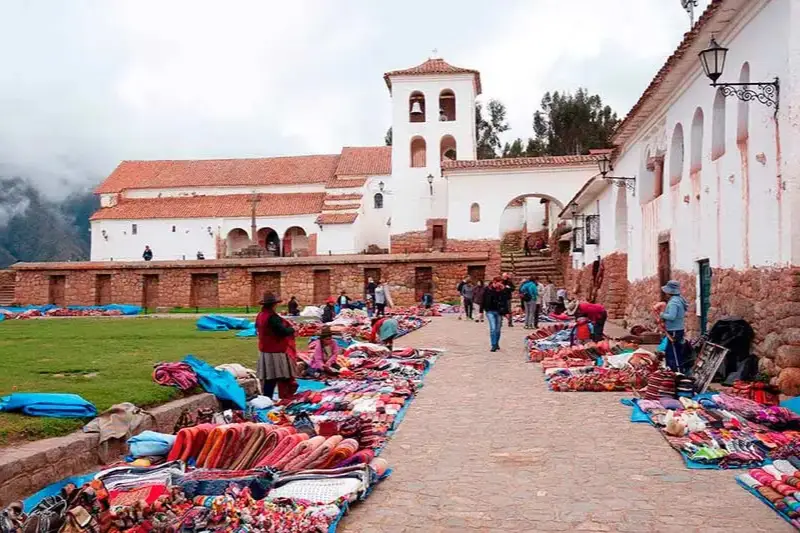
Step off the van and the first thing that hits is the air. Sharp, thin, carrying eucalyptus and woodsmoke at 12,500 feet. Chinchero does not ease you in. The elevation announces itself immediately and the town follows from there. Andean mythology gave this place the title Birthplace of the Rainbow, which connects to the light patterns that appear over the valley after rain at this altitude. Stand there after a storm and the title stops sounding poetic.
The chinchero district is not one thing. It is several things occupying the same space across different centuries. Inca stonework under a Spanish colonial church. Women spinning wool by hand the same way their grandmothers did. Agricultural terraces still manage water on the hillside. Travelers who stop here for a few hours tend to leave with a different picture of the Sacred Valley than the one they arrived with.
Chinchero fits naturally into a tour valle sagrado itinerary. Most operators include it alongside Ollantaytambo and Pisac, which places it in good company without requiring a separate dedicated trip.
Summary
Chinchero Peru sits at high altitude where Inca imperial stonework and a 17th-century Spanish church occupy the same physical ground. The chinchero ruins show precision masonry from Tupac Inca Yupanqui’s palace. Weaving demonstrations use hand-spun yarn and natural dyes. The Sunday market runs early and local. Colectivo from Cusco is cheap and direct. The Boleto Turistico covers site entry. May through October offers the most reliable conditions.
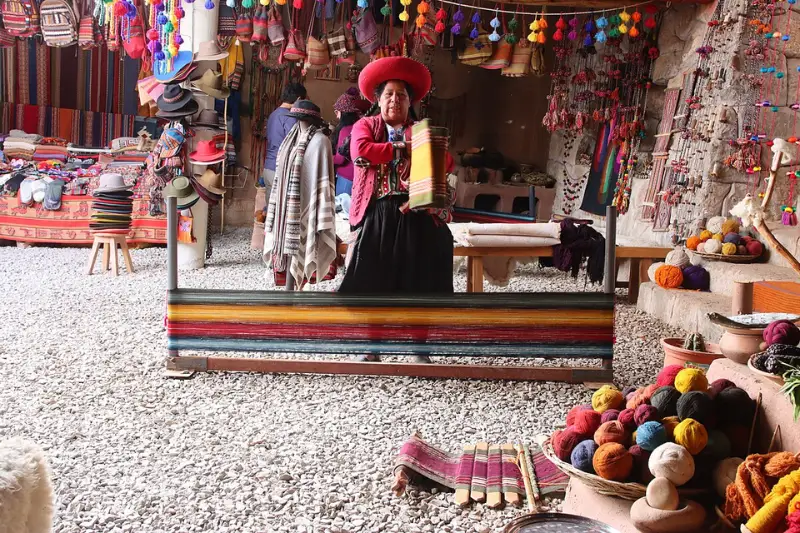
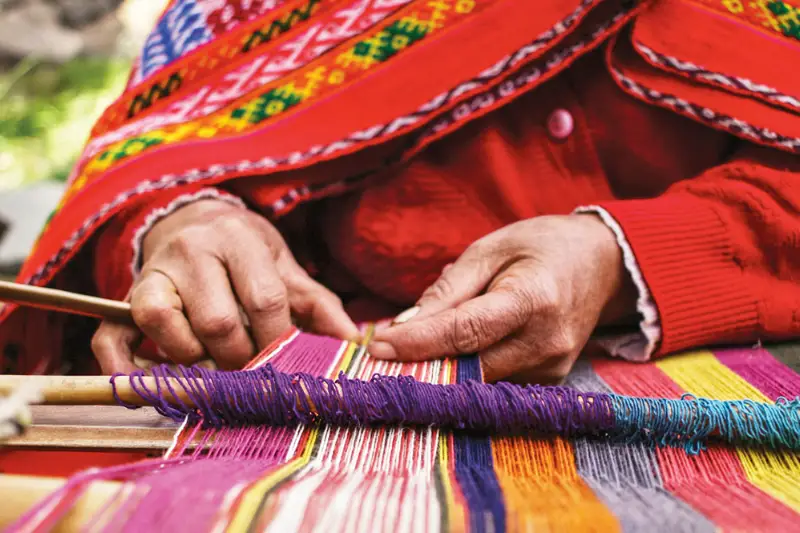
Transforming Insects and Roots into Art: The Secrets of Andean Weaving
The pushka comes first. A wooden hand-spindle that local women use to twist raw wool into yarn before anything reaches a loom. The motion is a wrist rotation that looks easy. It takes years to control properly. That spun yarn is the starting point for everything made in the chinchero district.
Color comes from the ground. Roots, leaves, insects. Processed into dyes that produce results synthetic formulas do not replicate. The main source is cochineal, a small white bug found on cacti. Crush it, mix with lime juice, and the result is a permanent scarlet. Chinchero Red. The chemistry is basic. The color is not.
Four checks for identifying real handmade textiles at any market in the region:
- Temperature: Genuine wool feels heavy and initially cool. Acrylic feels warm and plastic immediately.
- Texture: Hand-spun yarn varies in thickness slightly throughout. Machine yarn is perfectly uniform.
- Color: Natural dyes shift in different light. Synthetic dyes stay flat regardless of angle.
- Edges: Authentic pieces finish at the border through weaving. Machine-made pieces are cut and hemmed.
These work in Chinchero, Pisac, anywhere along the circuit.
Walking Through History at the Archaeological Park of Tupac Inca Yupanqui
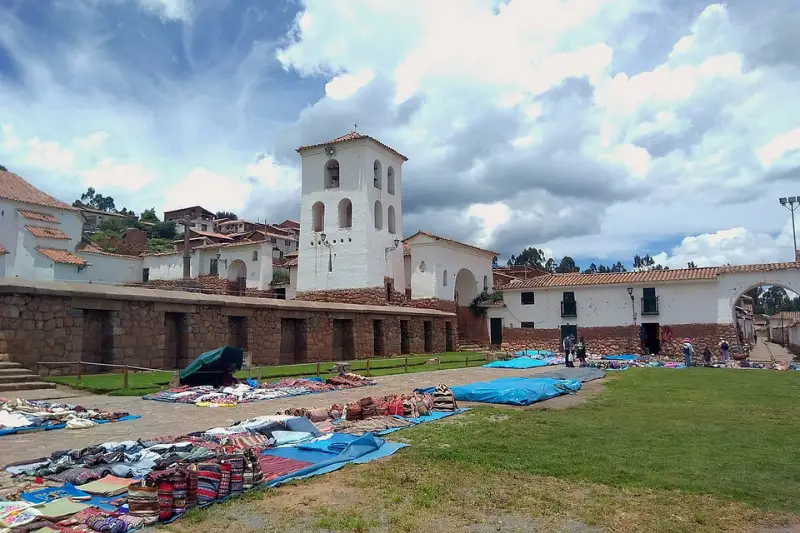
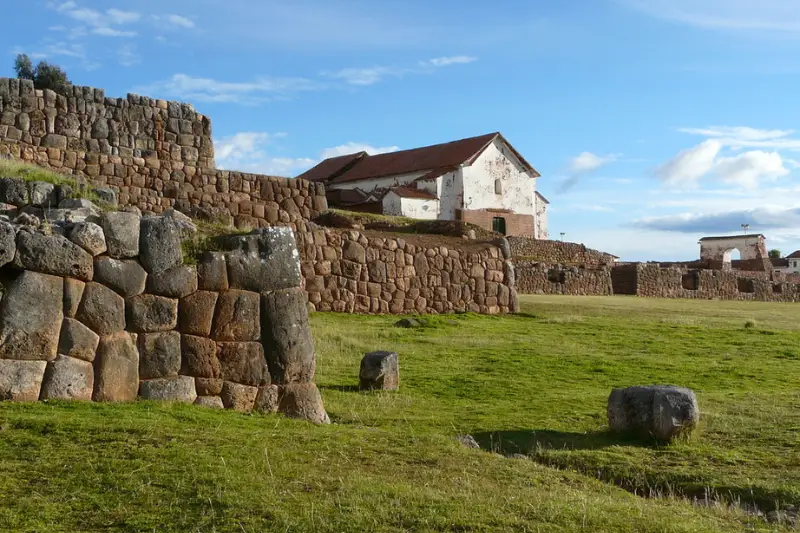
The church in the center of town is built on Inca foundations. Not nearby, not adjacent. Directly on top. The base of the colonial structure is carved Inca granite. Adobe rises from that. The seam between the two construction methods is visible from the street without searching for it. Gray fitted stone below. Rough mud brick above. Two building traditions, two centuries, one wall.
The chinchero ruins of Tupac Inca Yupanqui’s palace are the reason the stonework at the base looks the way it does. Imperial Masonry was a construction standard reserved for royal structures. The blocks interlock through precision cutting alone. No mortar. Centuries of Andean seismic activity and they have not shifted. That is not luck. That is engineering.
The terraces around the site managed microclimate. Stone retaining walls absorbed heat during the day and released it overnight. At this elevation, without that thermal management, consistent crop production at altitude is not viable. These were infrastructure, not decoration.
Walking the chinchero ruins takes about an hour at a pace that allows close examination. The site is not large. The quality of what is visible here matches anything at the better-known locations in the region.
Maras and Moray sit within the same general corridor as Chinchero and combine well as a single day circuit. The salt evaporation ponds at Maras and the circular Inca terracing at Moray cover different aspects of Andean engineering and agriculture that complement what the chinchero ruins demonstrate about construction and land use.
Navigating the Sunday Market and Logistics from Cusco
Colectivo from Cusco is the practical option. Shared vans run regularly, cost little, and follow the mountain road directly up. Travel time is roughly 45 minutes to an hour. The road climbs steadily and comfort expectations on a shared van at altitude should be adjusted before boarding.
For travelers combining Chinchero with multiple stops in a single day, private transport makes the logistics significantly more manageable. A hired vehicle allows flexible timing at each site, direct routing between locations, and luggage storage between stops, none of which colectivos accommodate reliably.
The Boleto Turistico is required for entry to the chinchero ruins. Buying it before arrival avoids the gate situation. The pass covers multiple regional sites so it absorbs its cost quickly across a multi-stop itinerary.
Market comparison:
| Feature | Chinchero | Pisac |
| Authenticity | High, locals actively trading | Moderate, tourist-oriented |
| Crowds | Quiet early, manageable later | Busy throughout |
| Products | Quality textiles, natural dyes | Mostly mass-produced souvenirs |
Before 9:00 AM on Sunday is the window. Vendors setting up, atmosphere local, crowd manageable. By mid-morning the day-trip groups arrive from Cusco and the character shifts.
Protecting Your Health and the Region’s Future
Chinchero sits above Cusco. People who handle Cusco without problems sometimes find the additional elevation here produces symptoms. Headache, fatigue, nausea that rest does not fully clear. The approach that works is Climb High, Sleep Low. Visit during daylight, return to lower elevation before sleeping.
Weather at this altitude changes fast. Morning sun, afternoon cloud, cold arriving without much warning. Layers that come on and off quickly handle that better than one heavy piece. Water intake should run higher than normal throughout the visit. Coca leaves are available everywhere in the region and take the edge off altitude symptoms for most people.
The chinchero district carries a different kind of pressure alongside the visitor management question. An international airport under construction on the plateau is physically reshaping the landscape. Earth-moving at that scale affects the agricultural terraces and the broader environment that the weaving traditions and market culture depend on. The debate between development and heritage is ongoing and not resolved. The site as it currently exists is worth seeing before that infrastructure changes it.
Why Chinchero Remains the Soul of the Sacred Valley
Nothing here is a replica. The chinchero ruins are original stonework. The weaving demonstrations use the actual technique, not a simplified version for tourists. The Sunday market sells produce grown at this elevation by people who live here. The colonial church sits on foundations that predate it by two centuries and those foundations are still holding.
Travelers combining Chinchero with a tour Machu Picchu with sacred valley itinerary typically structure the trip so Chinchero falls on the acclimatization day before the train to Aguas Calientes. That sequence works well physiologically and logistically. Lower elevation on Machu Picchu day after a higher-altitude acclimatization day in the valley.
Dry season, May through October, gives the most reliable conditions for a day trip. Rain happens year-round at 12,500 feet but less frequently and for shorter periods during those months. The light in the dry season is also clearer, which makes the valley views from the site significantly better.
Q&A
Why is Chinchero called the Birthplace of the Rainbow?
Weather patterns at 12,500 feet produce frequent vivid rainbows after mountain rain. The altitude, the clear air, the rapid weather shifts all combine to create light conditions that are genuinely different from lower elevations. The mythology attached a title to something that is also a meteorological fact.
What makes the chinchero ruins architecture distinctive?
A 17th-century colonial church built directly on top of Inca imperial palace foundations. The construction seam is visible without looking for it. The Inca stonework below demonstrates Imperial Masonry, interlocking granite blocks fitted without mortar. The surrounding terraces functioned as high-altitude microclimate management infrastructure for crop production.
How do I identify genuine handmade textiles?
Temperature, texture, color, edges. Real wool versus acrylic. Hand-spun thickness variation versus machine uniformity. Natural dye depth versus synthetic flatness. Woven borders versus machine hemming. Cochineal-dyed pieces produce a specific scarlet that synthetic alternatives do not replicate.
Transport and entry cost?
Colectivo from Cusco is the cheapest. Private transport is the better option for multi-stop days where timing flexibility matters. Boleto Turistico covers entry to the chinchero ruins and other regional sites. Buy it before arriving at the gate. Sunday market, before 9:00 AM.
Altitude and timing?
Climb High, Sleep Low. Layers, water, coca leaves as needed. Prior acclimatization in Cusco before visiting the chinchero district helps. May through October for dry season. The elevation here is higher than Cusco so the acclimatization work done in the city does not fully transfer.